Resources
Can You Learn Japanese With Video Games? An Honest Answer
Yes, video games can teach you Japanese words and build reading stamina, but not from zero and not alone. Japanese games assume you read kana and kanji. Start with a game made for learners, add graded reading for sentences and grammar, then move to commercial games with furigana once you know a few hundred words.
Yes, you can learn Japanese with video games, but they will not take you from zero to fluent on their own. A game gives you thousands of sentences you want to understand and no explanation of any of them. Games work best in two roles: a game made for learners for your first words, and commercial games as reading practice once you have a base.
Below: what studies found, what we measured ourselves, and what to play at each level. If you only want a list of titles, Language Game’s blog has one: the best video games to learn Japanese.
What does the research say about learning a language with games?
Research supports a careful yes: people do pick up language from games, but most studies are small, most concern English, and the best-known experiment shows that playing can get in the way of remembering words.
Three studies are worth knowing:
- A case study in Japanese. Jonathan deHaan (2005) followed one intermediate learner of Japanese who played a Japanese baseball video game for a month. His listening comprehension and kanji recognition improved. DeHaan credits the fact that the player controlled language that was repetitive, tied to context, and shown as sound and text together. It is one learner, and not a beginner.
- A correlation in English. Sylvén and Sundqvist (2012) tested 86 Swedish pupils aged 11 and 12. Those who played five hours a week or more outperformed moderate gamers, who outperformed non-gamers, on English tests. The authors note that stronger pupils may simply have chosen to play more.
- An experiment on attention. DeHaan, Reed and Kuwada (2010) paired 80 Japanese undergraduates. One played an English-language music game for 20 minutes while the other watched. The players recalled significantly less vocabulary than the watchers, and both groups forgot significant amounts of it over the two weeks of the study.
A game supplies input and motivation. Memory still needs slow reading and review.
Why is Japanese harder to learn from a game than English?
Japanese is harder to learn from a game because you cannot sound out a word you have never seen. The pupils in the Swedish study could already read the Latin alphabet. In Japanese, an unknown kanji gives you no pronunciation, so you cannot say the word or type it into a dictionary.
That is why furigana matter so much. With these small kana above the kanji, every line becomes readable aloud and searchable. Without them, a beginner is stuck on the first screen. See what furigana is.
The distance is also long. The U.S. Foreign Service Institute places Japanese among the languages that are “exceptionally difficult for native English speakers” and plans 88 weeks, or 2,200 class hours, for its students. Over that distance, practice you enjoy counts for a lot. See how long it takes to learn Japanese.
Where do you start if you cannot read Japanese yet?
If you cannot read kana yet, start with a game built for learners, because a commercial Japanese game assumes you already read. Language Game, a sister project of ours, is made for exactly this stage, so read this section knowing we are not neutral.
Language Game is a pixel-art adventure that runs in the browser on a computer, phone or tablet. You explore a small Japanese town, scan objects to get their name in writing and audio, and win the words in duels. Furigana and rōmaji sit above the words, and you can switch them off. It teaches 722 everyday words in 32 themes across 7 islands, with first sentences and short grammar lessons.
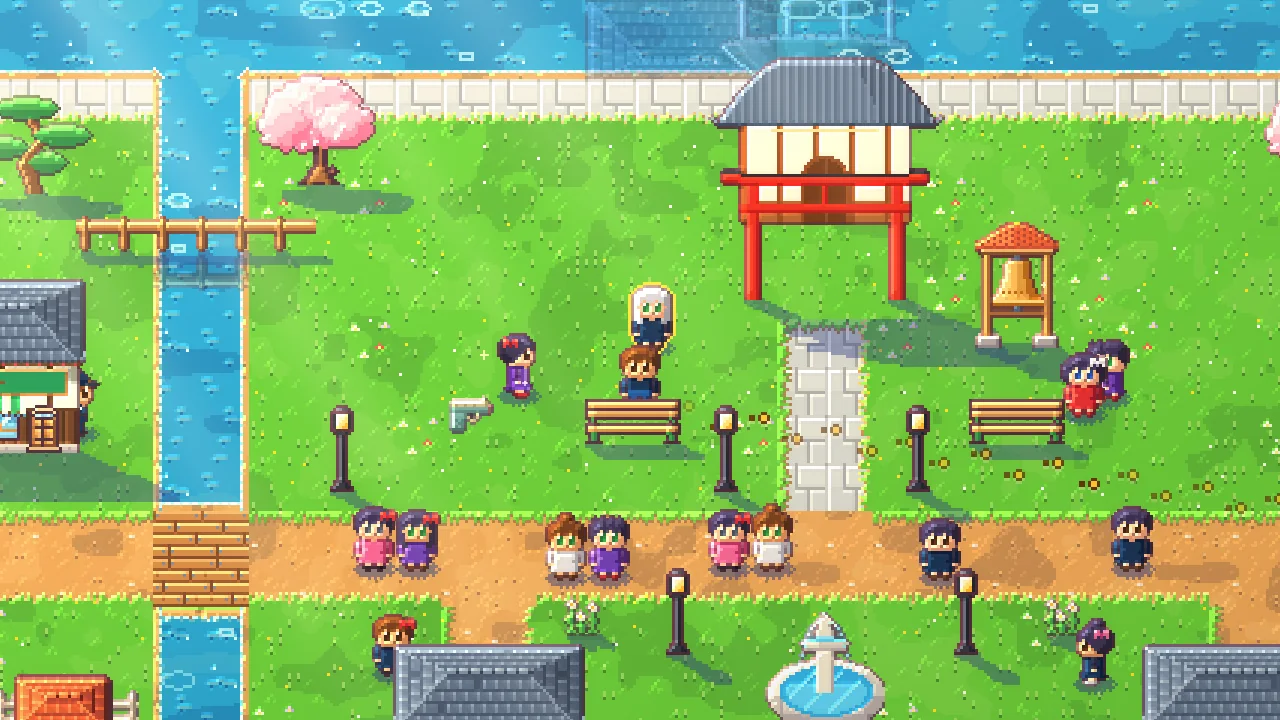
It is for complete beginners only, and it will not bring you to the level of the commercial games below. The first island is free, and the full game is a single payment with no subscription.
Play Language Game free in your browser
Learn hiragana and katakana at the same time: everything after this stage is written in them.
How far do a game’s words take you in real Japanese?
A beginner game’s words take you about a third of the way into a beginner text. In our November 2026 comparison of Language Game’s 722 words with the 60 Starter stories in Shinobi, 259 of the words appeared at least once, and they made up 32% of all the words on the page.
We call this the Language Game × Shinobi word overlap study. Starter is the first of Shinobi’s five grades. “Game words found” is out of 722.
| Grade | Words of text | Game words found | Share of text |
|---|---|---|---|
| Starter, 60 stories | 3,560 | 259 | 31.6% |
| Beginner, 59 stories | 5,651 | 304 | 32.0% |
| Intermediate, 60 stories | 14,115 | 363 | 27.9% |
| Advanced, 59 stories | 21,903 | 436 | 25.7% |
| Expert, 25 stories | 12,705 | 328 | 26.8% |
Across all 263 curriculum stories we measured, 554 of the 722 words (77%) turn up at least once. Adjectives, family words and kitchen words are almost all there: 41 of 44 adjectives, for example. Farm and clothing words are rarer, and トラクター (torakutā, tractor) and クロワッサン (kurowassan, croissant) never appear.
So the words are useful. What is missing is the glue. Four words, は (wa), です (desu), を (o) and が (ga), make up 26% of the Starter text on their own, and none of them is a word you can scan in a town. Verbs are the other gap: the game teaches 行く (iku, to go) and a story writes 行きます (ikimasu), which our count treats as a different word, as a true beginner would.
For comparison, a study of English learners by Laufer and Ravenhorst-Kalovski (2010) suggests 95% coverage of a text as the minimum for adequate reading and 98% as the optimum. One third is far from that, and reading sentences closes the gap.
How we counted: each story is split into words in our database and compared with the game’s list. Punctuation and proper nouns are excluded, the share of the text counts repetitions, and a game word written in kana is matched against the reading of the story word. The script is tools/language_game_overlap.py in our site repository.
What should you play at each level of Japanese?
Choose a game by furigana and sentence length, not by how much you love it. The details below were checked in November 2026 and can differ between versions.
| Your level | What to play | What to do beside it |
|---|---|---|
| No kana yet | A game made for learners, such as Language Game | Learn hiragana and katakana |
| Kana and a few hundred words | Animal Crossing: New Horizons: short everyday lines, furigana on the kanji | Graded stories, basic grammar |
| Around N5 to N4 | Pokémon Scarlet and Violet or Dragon Quest XI S, with the furigana option on | Look up five words per session |
| N3 and above | Persona 5 Royal, Ace Attorney: no furigana | Kanji study, native reading |
Two traps. Animal Crossing villagers speak gibberish, so you practise reading there, not listening. And Dragon Quest XI S only includes Japanese text in the copy sold on the Japanese eShop.
How do you turn play time into real learning?
You turn play time into learning by slowing down: in the experiment above, players recalled fewer words than watchers.
- Read each line aloud before you press the button. Text that waits for you is study material.
- Look up about five words per session. Pick the ones you have already seen several times.
- Replay a game you know. The story supplies the meaning, and you can focus on the words.
- Play 20 to 30 minutes on most days instead of four hours on Sunday.
- Keep sentences and speaking going elsewhere. Games rarely explain grammar and never correct you. For listening, see learning Japanese with anime.
Where does Shinobi fit?
Shinobi fits right after the learner game: it is where single words turn into sentences. Shinobi is our app, so take this as our view. It offers illustrated stories graded from Pre-N5 to JLPT N2, with audio on every page, a tap on any word for its meaning and a quiz after each story.
Our measurement shows why this step matters. The nouns and adjectives you collected in a game are there from the first stories, surrounded by the particles and polite verb forms the game could not give you.
You can read a few Pre-N5 stories or N5 stories on the web first. See also when you can start reading Japanese and the best apps to learn Japanese.
Where do these facts come from?
Studies were read at the abstract level and game details were checked in November 2026.
- DeHaan (2005), Foreign Language Annals 38(2): ERIC record EJ741805
- DeHaan, Reed and Kuwada (2010), Language Learning & Technology 14(2): ERIC record EJ895974
- Sylvén and Sundqvist (2012), ReCALL 24(3): Cambridge University Press
- Laufer and Ravenhorst-Kalovski (2010), Reading in a Foreign Language 22(1): ERIC record EJ887873
- Hours for Japanese: U.S. Department of State, Foreign Language Training
- Furigana and language options in games: Kana Conbini, The Japanese Page, WaniKani Community on Switch games and on Pokémon, GBAtemp, Game8
What’s the bottom line?
Video games can teach you Japanese words and keep you reading for years. They cannot explain grammar or make you speak. Start with a learner game for your first words, read graded stories to turn words into sentences, and open Animal Crossing in Japanese once the kana feel easy.
Frequently asked questions
Can you learn Japanese just by playing video games?
What level of Japanese do you need to play games in Japanese?
Are video games better than anime for learning Japanese?
Which Japanese video games have furigana?
How many Japanese words can you learn from a game?
Do you need a Japanese console or account to play in Japanese?
Start reading Japanese today
Leveled stories from beginner to JLPT N2 — with native audio, furigana and tap-to-translate. Free to start.